You've decided to buy a portable power station. Smart move. But now comes the question every Nigerian buyer asks: "Will it actually run my stuff?"
It's a fair question. Nobody wants to spend ₦400,000+ on a power station only to discover it can't handle their ceiling fan and TV at the same time. This guide gives you the complete breakdown — appliance by appliance, wattage by wattage — so you know exactly what each TURSAN power station tier can handle.
🚨 The Confusion Problem
Most power station listings throw around numbers like "1200Wh" and "600W output" without explaining what that means for YOUR appliances. Watts? Watt-hours? Surge watts? It all blurs together. This guide translates those specs into real Nigerian appliances and real runtimes.
Watts vs Watt-Hours: The 60-Second Explanation
Before we dive in, let's clear up the two numbers that confuse everyone:
- Watts (W) = how much power an appliance needs RIGHT NOW. Think of it as how wide the pipe is. A 100W fan needs 100 watts of power flowing to it at any given moment.
- Watt-hours (Wh) = how much total energy is stored in the battery. Think of it as how much water is in the tank. A 1,000Wh battery can deliver 1,000 watts for 1 hour, or 100 watts for 10 hours.
The rule: Your total connected appliances cannot exceed the power station's watt rating. And the watt-hour rating tells you how long they'll run.
⚡ Quick Runtime Formula
Runtime (hours) = Battery Capacity (Wh) x 0.85 / Total Appliance Watts. We multiply by 0.85 to account for inverter efficiency losses. This gives you a realistic estimate, not a theoretical maximum.
Common Nigerian Appliance Wattages
Before matching appliances to power stations, here are the real-world wattages of appliances commonly used in Nigerian homes and businesses:
| Appliance | Typical Wattage | Category |
|---|---|---|
| Phone charger | 5-25W | Electronics |
| LED bulb | 7-15W | Lighting |
| Wi-Fi router | 10-15W | Networking |
| Laptop | 45-65W | Computing |
| POS terminal | 10-20W | Business |
| Table fan | 40-55W | Cooling |
| Standing fan | 50-75W | Cooling |
| Ceiling fan | 60-80W | Cooling |
| 32" LED TV | 35-55W | Entertainment |
| 43" LED TV | 60-80W | Entertainment |
| DSTV decoder | 20-30W | Entertainment |
| Desktop monitor | 25-40W | Computing |
| Inkjet printer | 30-50W | Business |
| Small fridge (100L) | 80-120W (running) | Cooling |
| Medium fridge (200L) | 120-180W (running) | Cooling |
| Hair clipper | 15-25W | Salon |
| Blender | 300-600W | Kitchen |
| Iron (pressing) | 1,000-2,200W | Laundry |
| Microwave | 800-1,200W | Kitchen |
Tier 1: TURSAN YC600S (600W Output)
Best For: Remote workers, POS agents, students, small vendor stalls
The YC600S is your entry-level workhorse at ₦439,999. Don't let "entry-level" fool you — 600W handles the daily essentials that most Nigerians actually need during an outage.
What it CAN run simultaneously:
- Laptop (65W) + Wi-Fi router (12W) + phone charger (20W) + LED bulb (10W) = 107W total. Runtime: ~5 hours
- 32" LED TV (50W) + DSTV decoder (25W) + standing fan (55W) + 2 LED bulbs (20W) = 150W total. Runtime: ~3.4 hours
- POS terminal (15W) + table fan (45W) + 3 LED bulbs (30W) + phone charging (20W) = 110W total. Runtime: ~4.6 hours
- Desktop monitor (35W) + laptop (65W) + router (12W) + desk lamp (10W) = 122W total. Runtime: ~4.2 hours
What it CANNOT run:
- Microwave (800W+) — exceeds output capacity
- Iron/pressing iron (1,000W+) — way over limit
- Blender (300-600W) — some models may work but will push the limit
- Any appliance with a compressor startup surge above 600W
Tier 2: TURSAN YC1100 (1000W Output)
Best For: Home offices, salons (basic), small shops, content creators
At ₦539,999, the YC1100 is the sweet spot for most Nigerian homes and small businesses. The jump from 600W to 1000W opens up significantly more combinations.
What it CAN run simultaneously:
- Laptop (65W) + external monitor (35W) + router (12W) + standing fan (60W) + 4 LED bulbs (40W) + phone charging (20W) = 232W total. Runtime: ~4 hours
- 43" LED TV (75W) + DSTV (25W) + ceiling fan (70W) + small fridge (100W running) + 3 LED bulbs (30W) = 300W total. Runtime: ~3.1 hours
- Blender (500W) — yes, it can handle it for smoothie runs
- Hair clippers (20W) + standing fan (60W) + LED lighting (40W) + phone charging (40W) + music speaker (30W) = 190W total. Runtime: ~4.9 hours
What it CANNOT run:
- Microwave (most models exceed 1000W)
- Pressing iron (1,000-2,200W) — too risky even if rated wattage seems close
- Hair dryer on high (1,200W+)
Tier 3: TURSAN YC1200 (1200W Output)
Best For: Family homes, salons with dryers, small restaurants, offices
The YC1200 at ₦769,999 crosses an important threshold: it can handle small microwave ovens and some hair dryers. The larger battery capacity also means longer runtimes for moderate loads.
What it CAN run simultaneously:
- Small microwave (800W) — for quick reheating, not extended cooking
- 43" TV (75W) + DSTV (25W) + medium fridge (150W running) + ceiling fan (70W) + 5 LED bulbs (50W) + router (12W) = 382W total. Runtime: ~2.7 hours
- 2 laptops (130W) + 2 monitors (60W) + router (12W) + printer (40W) + 2 fans (110W) + lighting (40W) = 392W total. Runtime: ~2.6 hours
- Hair clipper (20W) + hair dryer on LOW (500W) + lighting (60W) + fan (55W) + music (30W) = 665W total. Runtime: ~1.5 hours
⚡ Pro Tip: Stagger Your Heavy Appliances
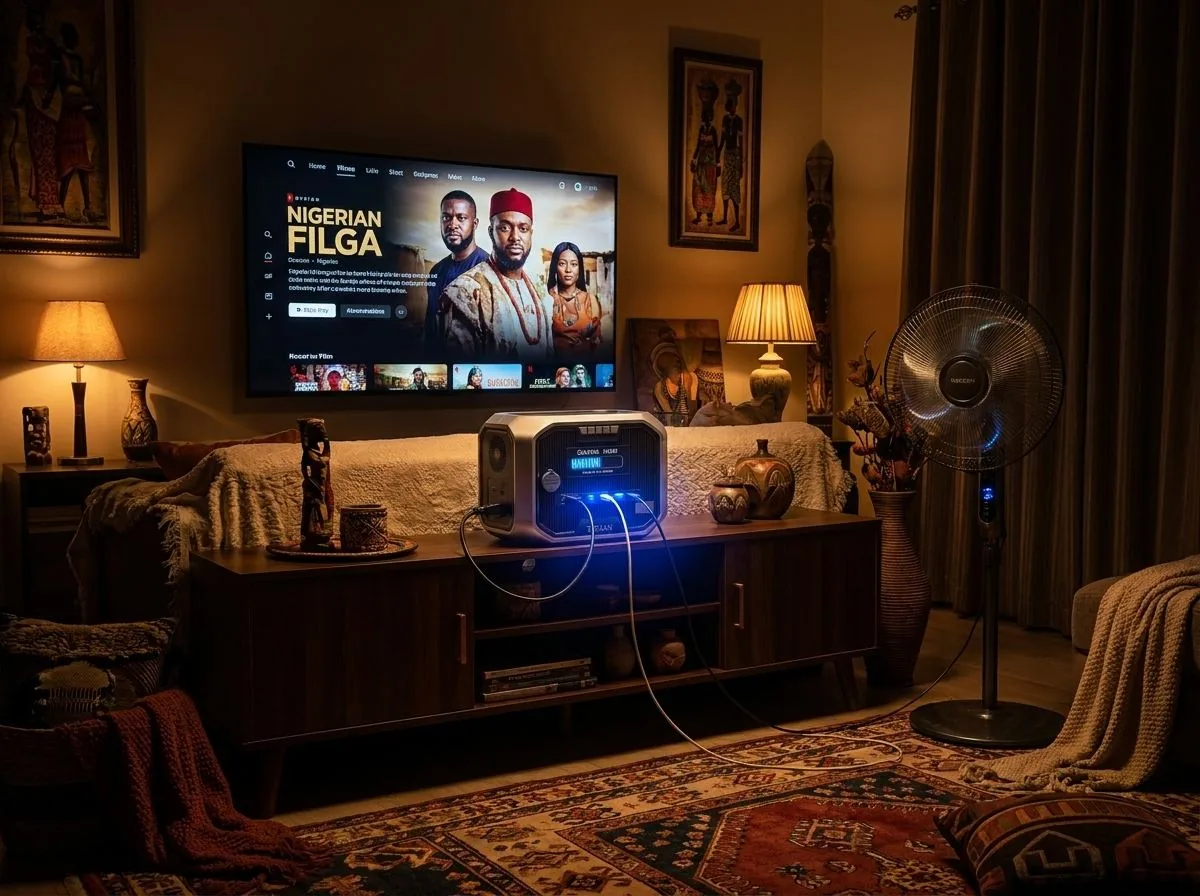
You don't need to run everything at once. Use the microwave first, then switch to fan + TV + lights. Smart power management can make a 1200W station feel like a 2400W unit for most households.
Tier 4: TURSAN YC2400 (2400W Output)
Best For: Large homes, businesses with fridges, event planners, workshops
The YC2400 at ₦1,350,000 is a serious unit. At 2,400W continuous output, this handles nearly everything except heavy industrial equipment, AC units, and electric cookers.
What it CAN run simultaneously:
- Medium fridge (150W) + 43" TV (75W) + DSTV (25W) + ceiling fan (70W) + 10 LED bulbs (100W) + router (12W) + laptop (65W) + phone charging (40W) = 537W total. Runtime: ~3.8 hours
- Microwave (1,000W) + fridge (150W) + lighting (60W) + fan (70W) = 1,280W total. The microwave runs for 10 minutes, then remaining load runs for hours
- Multiple business stations: 3 laptops (195W) + 2 printers (80W) + router (12W) + 3 fans (180W) + POS terminal (15W) + lighting (80W) + CCTV system (40W) = 602W total. Runtime: ~3.4 hours
- Pressing iron (1,200W) — yes, for the first time in our lineup, you can iron clothes on backup power
What it still CANNOT run:
- Air conditioner (1,500W+ with 3,000W+ startup surge)
- Electric cooker/hotplate (2,000W+)
- Industrial freezers
- Washing machine with heater (2,000W+)
Side-by-Side: All Four Tiers Compared
| Feature | YC600S | YC 1100 | YC 1200 | YC 2400 |
|---|---|---|---|---|
| Output | 600W | 1000W | 1200W | 2400W |
| Price | ₦439,999 | ₦539,999 | ₦769,999 | ₦1,350,000 |
| Battery | BYD LiFePO4 | BYD LiFePO4 | BYD LiFePO4 | BYD LiFePO4 |
| Cycles | 4,000+ | 4,000+ | 4,000+ | 4,000+ |
| Runs a fridge? | No | Small (100L) | Medium (200L) | Yes, easily |
| Runs a TV? | 32" LED | Up to 43" | Up to 55" | Any LED TV |
| Runs a microwave? | No | No | Small (800W) | Yes |
| Solar Input | MPPT | MPPT | MPPT | MPPT |
| Inverter | Pure Sine Wave | Pure Sine Wave | Pure Sine Wave | Pure Sine Wave |
| Warranty | 2 years | 2 years | 2 years | 2 years |
How to Pick Your Tier: The Decision Framework
Step 1: List every appliance you'll run during an outage
Be honest. Don't include things you "might" use. Focus on what you absolutely need when NEPA takes the light.
Step 2: Add up the wattages
Use the appliance table above. Add them all together. This is your "total load."
Step 3: Pick the station with at least 20% headroom
If your total load is 500W, don't buy a 600W station — buy the 1000W. That headroom protects against startup surges and gives you room to add appliances later.
Step 4: Consider runtime needs
How long are your typical outages? If you regularly face 6-8 hour blackouts, you may need a higher-capacity model even if a lower-wattage one can handle the load — because you need the battery to last longer.
"Buy for your ceiling, not your floor. The power station that's slightly more than you need today is exactly right for tomorrow."
Real-World Nigerian Setups
The University Student
Laptop (65W) + phone charging (20W) + desk lamp (10W) + small fan (40W) = 135W. The YC600S runs this for about 4 hours. Perfect for studying through evening outages.
The Lagos Remote Worker
Laptop (65W) + monitor (35W) + router (12W) + standing fan (60W) + LED lighting (20W) = 192W. The YC 1100 handles this for about 4.8 hours — enough for a full work afternoon during an outage.
The Family Living Room
43" TV (75W) + DSTV decoder (25W) + ceiling fan (70W) + 5 LED bulbs (50W) + phone charging (40W) + router (12W) = 272W. The YC 1200 keeps the family comfortable for about 3.7 hours.
The Shop Owner
Display fridge (150W) + POS terminal (15W) + lighting (80W) + 2 standing fans (120W) + CCTV (30W) + phone charging (20W) = 415W. The YC 2400 keeps the entire shop running for about 4.9 hours.
Frequently Asked Questions
What is the difference between watts and watt-hours?
Watts are how much power an appliance needs right now. Watt-hours are how much energy the battery stores.
How do I estimate runtime?
Runtime (hours) = battery capacity (Wh) × 0.85 ÷ total appliance watts. The 0.85 accounts for inverter losses.
Can I connect appliances above the power station rating?
No. Your total connected appliances must stay below the power station’s watt rating.
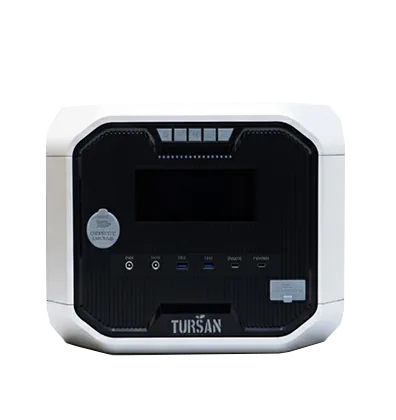
TURSAN YC1200 Portable Power Station
The versatile choice for Nigerian homes and businesses. 1200W pure sine wave output, BYD LiFePO4 battery with 4,000+ charge cycles, MPPT solar input. Runs your fridge, TV, fans, and lights simultaneously. 2-year warranty included.